|
|
Notes on Endurance and the Temperature/Humidity Issue (7/1/2006)
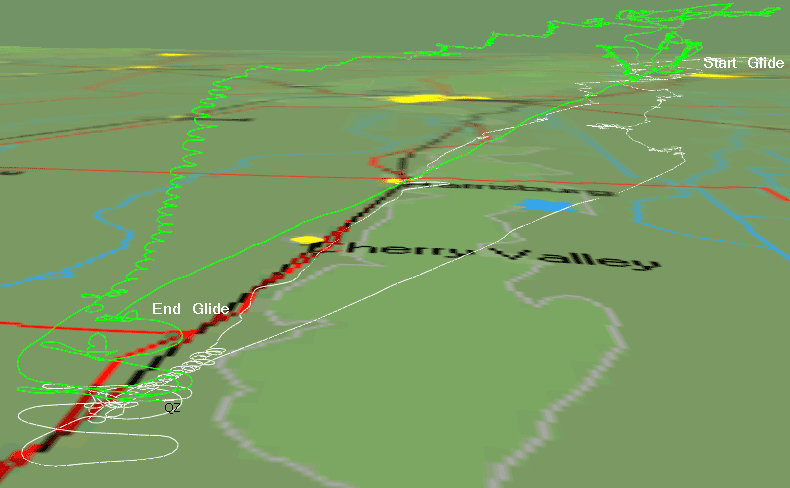
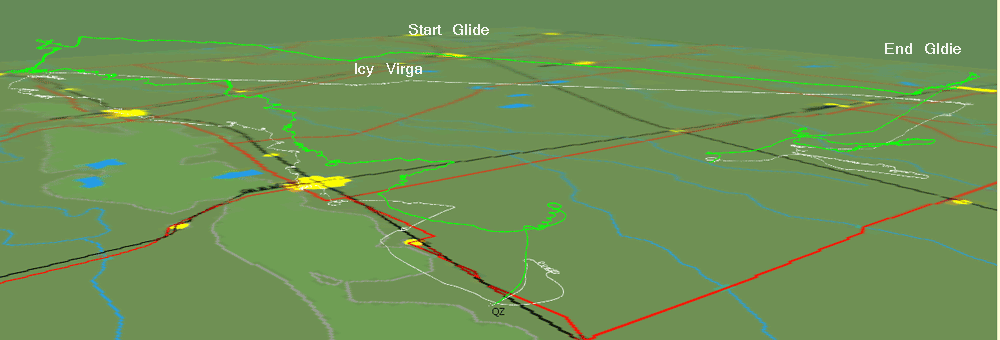
After flying one year with full-span upper-surface deturbulated wings, Dr. Sinha replaced the original deturbulators with the revised design. Although, he still has to replace several 18" strips that are not up to standards, it seems clear that the humidity issue is solved. Meanwhile, I have resumed normal cross country soaring with newly deturbulated wings and can report that my glider is performing very well. I have no qualms about taking it on tasks that push my chances of making it back home. On long glides at low speeds and high it normally outperforms the glide slope computed by my Cambridge 302 (configured for the normal 36:1 Standard Cirrus polar). As an example, I present a final glide on 7/1/2006 (click image on right). This flight ended with a 13 nm glide at an average airspeed of 85 kts into a 17 kt headwind. The elapsed time was 11.7 minutes and the altitude loss was 3048 ft. The average sink rate was 260 ft/min. This compares to my baseline polar at 360 ft/min, for a 25% improvement. Of course, this one case isn't conclusive since gliders always experience wild variations in sink rates depending on the air they fly through. However, I cite this case as typical of the performance I now expect. Another question is "what is the effect of rain and ice?" I've had two experiences of that sort. In the first case, I took drag rake and sink rate measurements while flying at around 10,000 feet in icy virga. Both measurements were ugly, especially the drag. However, at lower altitudes, the wings cleared off and everything returned to normal. I was able to retake the bad data points and they fit beautifully into the overall polar.
One thing about this flight, it ended with a landout in a soggy bean field. The glider got dirty, but the deturbulators required no maintenance except the usual cleaning before every flight. This 36 year old glider won the day with the longest flight in a field of seven competitors, some flying the latest technology. Only three got away from the home field. Granted, a task around rain cells in rapidly changing conditions is largely a question of timing and chance, but glider performance was definitely a factor. One point should not go unmentioned. These two flights, among others, stand as clear testamony that the Sinha deturbulator does in fact work. Compare these flights to the performance one would expect of a modern composite glider modified by sticking ordinary duct tape on the upper wing surfaces from root to tip in a region that is not under the separation bubble. I would never set out on a cross country flight in such a glider. Yet, this one is obviously flies very well. Even if it were flying no better than normal, something good must be happening to overcome the drag penalty of 14 meters of tape on the wing tops. That this glider is flying with its wings so modified is common knowledge to everyone in the Memphis Soaring Society (hosts of the 2007 SSA convention). Ask anyone. Now that we are flying with what appears to be predictable performance, we expect soon to take a good performance polar of the modified glider. If this meets expectations, we intend to have it tested independently. Meanwhile, Dr. Sinha continues to develop ways to manufacture his deturbulator with sufficient precision to ensure proper operation. Another continuing line of work is to better establish the theoretical foundation of the flow/surface interaction that produces the deturbulation action. For this we will use the LINFLOW software package together with ANSYS/ED.
Jim Hendrix |
| © Copyright 2003-2012 Jim Hendrix | Disclaimer |